


Resources
Why ZeroDrift Built a Specialized SLM for AI Enforcement

Anchor is ZeroDrift’s small language model for compliance enforcement. Here’s why we chose an SLM, and how post-training shapes the model. We also explain why specialization could play a bigger role in the AI stack as agents take on more work.
By Corey Hobbs, Founding Principal PM
When we started building Anchor, one of our first decisions was picking the right kind of model for AI enforcement.
The obvious option was a general-purpose LLM. Frontier models are remarkably capable, and with the right prompt, they can analyze regulations, interpret complicated language, and identify potential compliance problems.
However, enforcement asks for something much more specific.
The model has to understand what a message means and how written rules apply to it. Then, it needs to turn that analysis into a decision that systems can act on.
At ZeroDrift, that means every message ultimately receives one of four verdicts: Pass, Fix, Block, or Escalate.
The combination of language understanding and a tightly defined output shaped how we built Anchor. Rather than use a general-purpose model for every enforcement call, we built a small language model, or SLM, that could be post-trained specifically for compliance enforcement.
Why We Chose an SLM for AI Enforcement
The difference in scale between an SLM and a frontier model can be enormous. In the ranges we use when thinking about these systems, SLMs are generally under 10 billion parameters, while frontier models can range from roughly 80 billion into the trillions. Depending on the models being compared, that can make an SLM 10 to 50 times smaller.
For context, parameters are the values a model learns during training. More parameters give a model more capacity, provided it has enough training data and compute to make effective use of them.
That scale makes sense for systems designed to handle a broad range of subjects and tasks. Anchor, however, operates in a much more defined environment. Communications and requirements can vary widely, but the underlying task remains the same: understanding how written rules apply to a communication, and determining what should happen next.
Consider a financial promotion generated by an AI system. Anchor may need to identify what the message is claiming, whether the claim is permitted, whether a required disclosure is present, and whether language elsewhere in the message changes the meaning of the claim. You can’t answer any of those questions by looking for a particular word or phrase. The meaning depends on the language and context of the entire message.
An SLM gives us that language capability in a model that can be specialized around a specific domain. While frontier models are built to handle a broad range of tasks, an SLM can concentrate its training on the distinctions that matter for enforcement.
There’s also an architectural reason for that specialization. Anchor is built for the send path, which means the enforcement check happens after a message is generated but before it is sent. AI systems may call a model like this every time they communicate, so compute, latency, and cost become key considerations. An SLM requires a fraction of the compute of a general-purpose model and is easier to adapt around a specific task.
How Anchor Is Trained
An SLM’s size makes it more efficient to run, but that’s only part of why it's well-suited for enforcement. We can also develop its language capabilities around the specific demands that Anchor needs to handle.
Specialization starts with a base model that already understands language, context, and the relationships between ideas. We post-train Anchor from that foundation, allowing us to develop deeper expertise in the kinds of problems it will encounter in regulated communications.
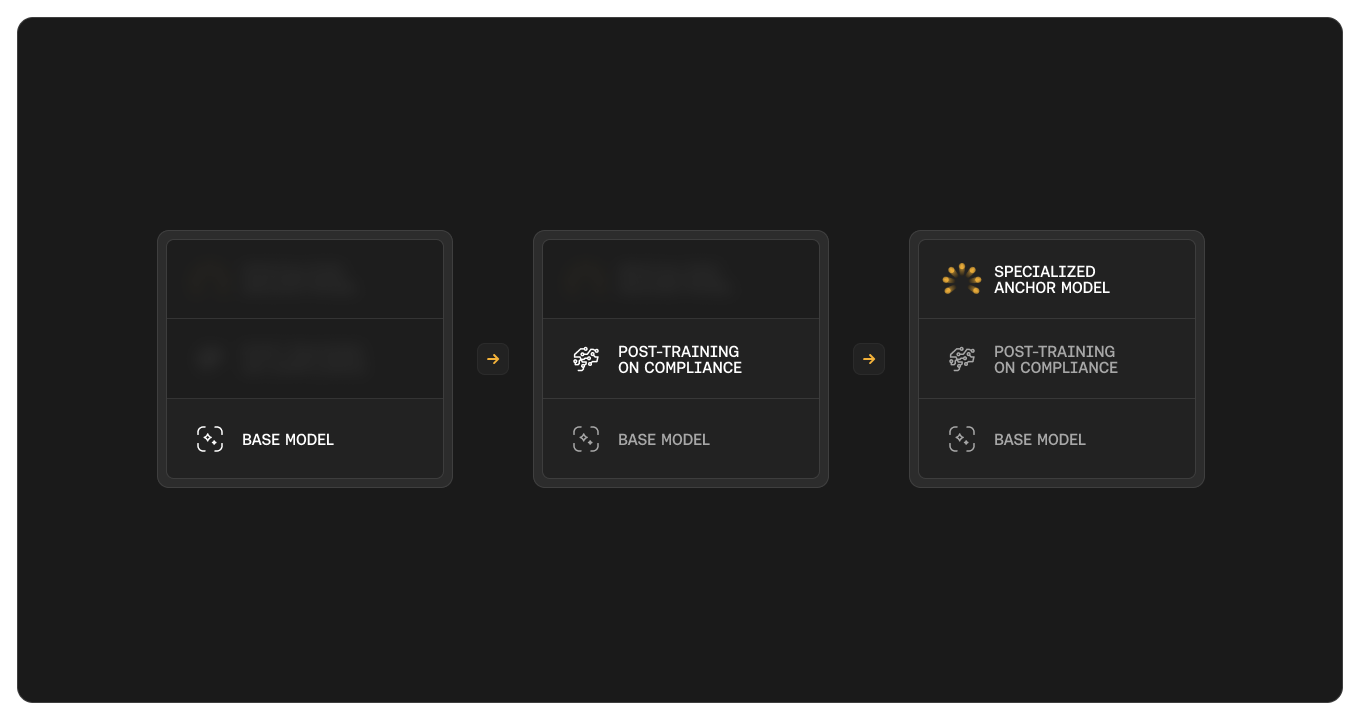
In the current Anchor family, 3.0 Mini and our flagship model are post-trained from Gemma E4B, a 9-billion-parameter model with 4 billion active parameters. Anchor 3.0 Max is post-trained from Qwen3.8-27B, a 27-billion-parameter model.
We also use Low-Rank Adaptation, or LoRA, to incorporate a company’s own policies into our flagship model through a trained adapter. LoRA allows us to refine an existing model by training a much smaller set of additional parameters rather than retraining all of its original weights. This makes it possible to build on the model’s existing language abilities while directing its capacity toward a more focused purpose.
For Anchor, post-training concentrates on the distinctions that shape compliance decisions. A subtle change in wording can alter a claim. Context elsewhere in a message can change how a requirement applies. Different violations can also call for different outcomes. By learning these patterns across regulated communications, Anchor develops the domain expertise needed to interpret written requirements and turn that understanding into an enforcement decision.
How Anchor Learns to Generalize
Post-training depends heavily on the quality of the examples behind it. Anchor needs to learn the patterns that separate compliant communications from violations, including cases where the difference is subtle.
We build domain-specific datasets of communications paired with the appropriate compliance decisions. Each example is annotated and labeled, giving Anchor concrete cases from which to learn how differences in a message can affect the outcome.
Consider two messages making similar claims about the same financial product. One may satisfy the applicable requirements while the other does not. The difference could be a missing disclosure, the strength of the claim, a qualification elsewhere in the message, or a few words that change its meaning. Seeing many variations helps Anchor actually learn the relationships behind those decisions instead of simply memorizing particular phrases.
However, training examples only tell us what Anchor has learned before. To see how well that knowledge carries over, we evaluate it against a separate dataset it did not encounter during training. A new message may express a familiar compliance issue in a completely different way. Anchor still needs to recognize what is happening and reach the appropriate decision.
The result is a continuous development cycle, and resembles this process:
- Train on domain-specific examples paired with labeled decisions.
- Evaluate against separate, unseen examples.
- Analyze where the results are wrong and why.
- Refine the data and training, then test again.
The goal is generalization. Real communications will not follow a fixed script, and the same compliance issue can appear in countless forms. Anchor needs to apply what it has learned when the words are new, but the underlying issue is familiar.
From Reasoning to a Verdict
Understanding a compliance problem is only part of Anchor’s job. It also has to decide what should happen to the message.
The need for a decision changes what we ask of the model. A general-purpose LLM can analyze a communication and explain its findings at length. Anchor has to go further and resolve its analysis into one of four verdicts:
- Pass: The message meets the active requirements and can continue unchanged.
- Fix: A violation can be corrected, and the fixed message is checked again.
- Block: We stop the message before it sends.
- Escalate: The case requires human judgment before the message is sent.
Reaching the right verdict can still require substantial reasoning. A violation is not always obvious, and neither is the appropriate response. Anchor may need to interpret what a claim means in context, identify the requirement that governs it, and determine whether the problem can be corrected or requires human judgment.
This is where classification comes in. Anchor’s reasoning is directed toward a defined set of outcomes. It evaluates the communication, works through the relevant compliance questions, and ultimately classifies the result as Pass, Fix, Block, or Escalate.
A defined verdict gives the reasoning a practical endpoint. Instead of returning an open-ended analysis that another system still has to interpret, Anchor produces a verdict that can determine what happens to the message next.
Why Anchor Combines Language Reasoning With Deterministic Rules
Building Anchor also meant thinking carefully about how compliance decisions are made.
Take a message with a required disclosure. Checking whether the disclosure appears can be relatively straightforward. But its presence does not necessarily tell you whether the message is compliant. The surrounding language could contradict it, undermine it, or change how a reader understands the claim.
We wanted Anchor to account for both parts of that problem. Its enforcement SLM and deterministic rules engine run in parallel, and their results are reconciled into a single verdict.
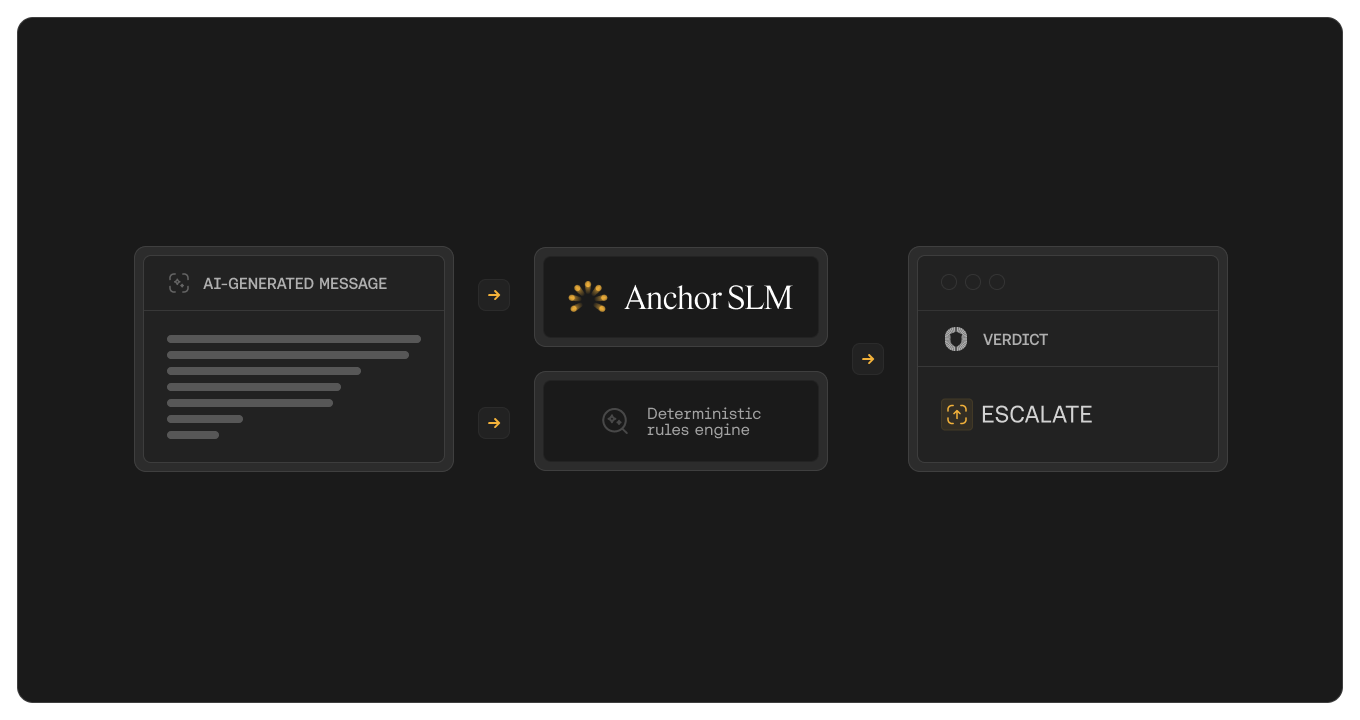
Deterministic logic gives us a precise way to apply requirements that can be expressed as explicit checks. The SLM handles the judgment that depends on language, nuance, and the meaning of the communication as a whole.
Together, they let Anchor apply each requirement in the way it calls for. Clear conditions can be checked directly, while questions of meaning can be interpreted in context.
Building for the Send Path
Anchor does its work at a specific moment: after an AI system generates a message, but before that message reaches a person or another system. We call this the send path.
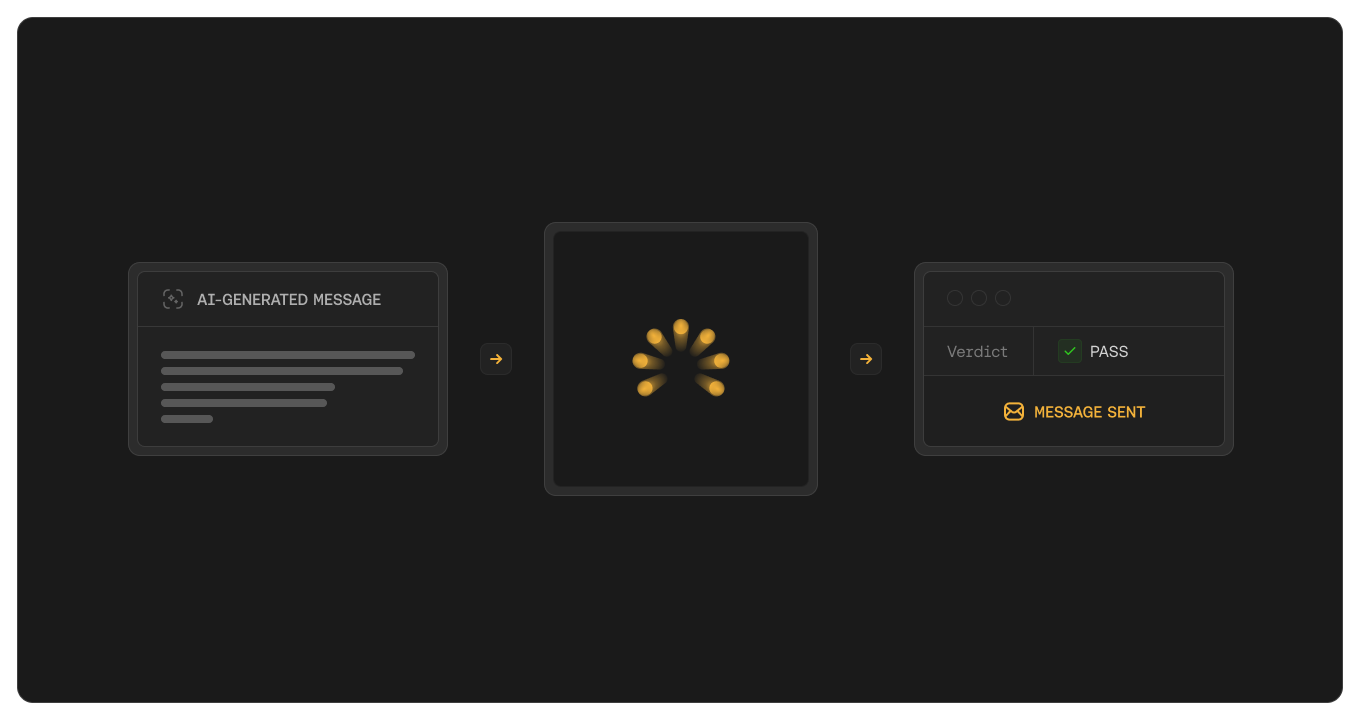
Through the Enforcement API, an application sends the message to the ZeroDrift Enforcement Runtime and gets back a verdict, the rule cited, a suggested fix when applicable, and an evidence ID. The decision arrives while the application can still act on it.
Operating in the send path puts a few requirements into focus:
- The check has to happen before delivery. Enforcement sits inside the communication flow, so the work has to be completed while there is still an opportunity to change what happens to the message.
- Every message can create another enforcement call. As an AI system produces more communications, the enforcement workload grows with it. The economics and efficiency of each call therefore matter at scale.
- The result has to be usable by software. The application needs a clear decision it can act on immediately, rather than an analysis that requires another layer of interpretation.
AI agents make these requirements even more important. An AI assistant might draft an email and wait for a person to review it. But an agent can generate that same email and continue through the workflow on its own. As agents take on more responsibility for generating and sending communications, enforcement needs to operate alongside them, checking messages as they are produced while preserving human review for cases that require it.
The Future of Specialized Models
We think specialization will become a more important part of the AI stack as agents take on larger roles inside companies. Frontier models will continue to push the boundaries of what AI can do across a huge range of tasks. Alongside them, smaller models can develop deep expertise in the specific tasks that a given AI system relies on.
Enforcement fits that pattern well. It has a defined purpose, a specialized body of knowledge, and a limited set of outcomes. Those characteristics give us the ability to shape the model around the demands of the task, developing deeper expertise in the language, rules, and decisions it needs to handle.
The opportunities for this kind of specialization could expand as the technology evolves. Continued advances in chips and computing may make specialized models practical in more environments, including directly on phones, laptops, and other hardware. In turn, this could reduce the infrastructure required to deploy purpose-built models and broaden where they can be used.
For us, Anchor shows what that focus can look like in practice. Building an SLM around one demanding job gave us the freedom to optimize every part of it for enforcement. Its training, reasoning, architecture, and deployment all follow from that choice. As AI becomes more capable, we expect to see more models developed with the same degree of specialization. Anchor is one example of where that can lead: a system with clearly defined responsibilities, and deep expertise in the work it performs.